
Joining an association, federation or foundation is the easy part. Extracting real value from it? That requires treating membership as an active investment, not a passive subscription.
Here is how to make your membership count — whether in Brussels or at Belgian federal and regional level.
By Eda Aygen and Stefanie Pollet, Partners at SoWhatCommunications powered by Square Circle
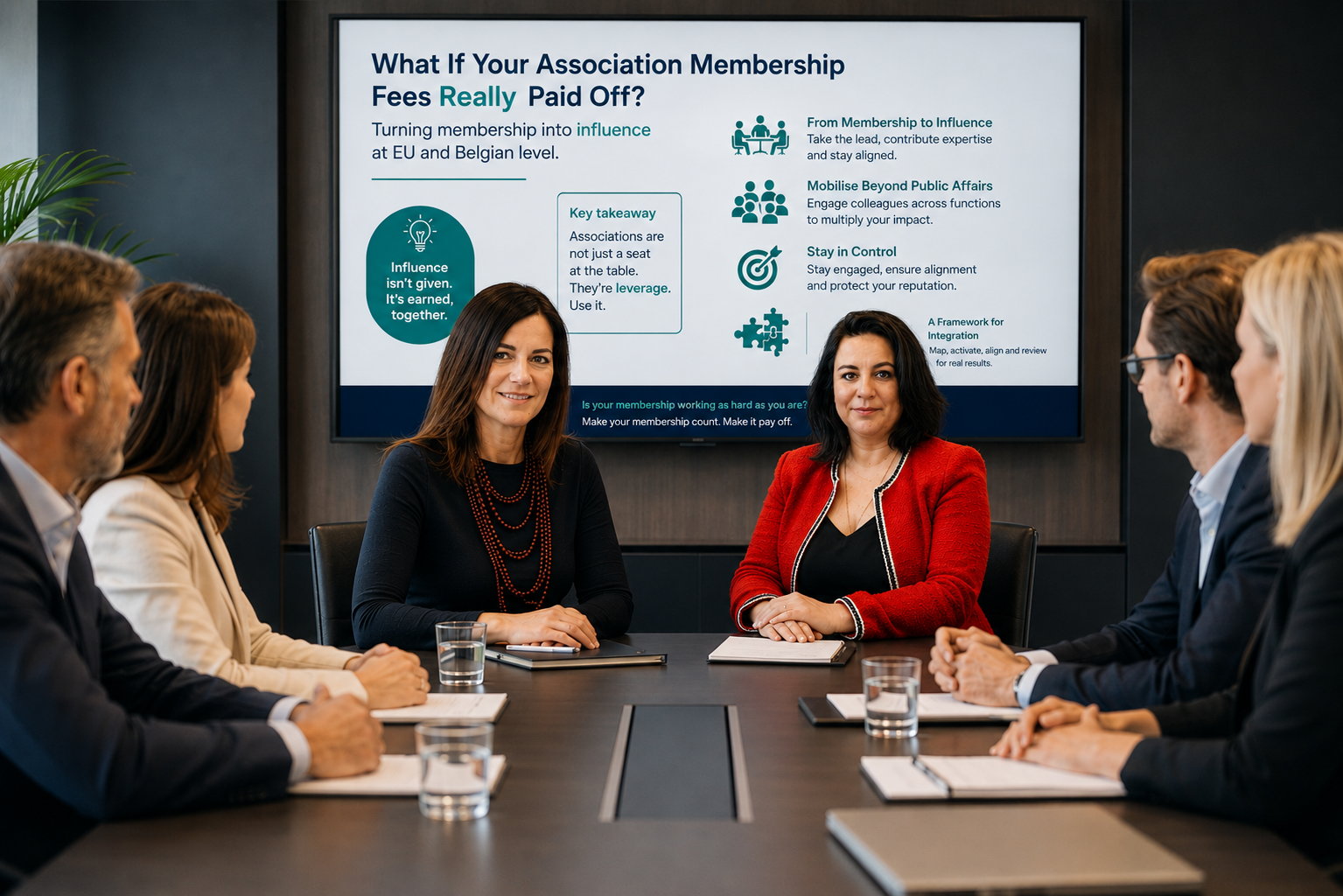
From Membership to Influence
Take leadership positions. Chairing a working group, sitting on an executive committee, or leading a task force puts your experts in the room where positions are drafted — before the document goes to a plenary vote where your view can be outvoted. Leadership roles also build personal relationships with officials and policymakers that outlast any single file.
This applies equally at EU and Belgian level. Federations like VBO-FEB, VOKA, UWE, or BECI offer direct channels to federal and regional governments. A seat at the table in these bodies can shape positions that feed into Belgian negotiating stances in the Council — or influence domestic regulation directly.
Contribute technical expertise. Brussels, as well as Belgium, run on position papers, technical briefings, and impact assessments. Policymakers are generalists navigating complex dossiers; they rely on industry expertise to understand second-order consequences. Companies that invest in high-quality technical contributions become indispensable and build lasting credibility.
Align association strategy with internal advocacy. The positions your company supports through an association must be consistent with what your public affairs team says in bilateral meetings and what your CEO says publicly. Consistency amplifies your message; mixed signals dilute it.
Know when to complement with direct engagement. Associations work by consensus — valuable for building broad coalitions, but sometimes insufficient for your specific priorities. Smart companies use association membership and direct advocacy as reinforcing channels, deploying each where it works best.
Mobilise Beyond Public Affairs
Association membership is not just a public affairs matter. Across your organisation, Marketing Directors sit in industry communications bodies, Sales Directors engage in commercial federations, Finance Directors engage in financial, tax, and capital markets associations, IT leaders participate in technology alliances, HR Directors contribute to employer organisations, and General Counsels are active in legal and compliance networks.
Too often, these memberships operate in silos — disconnected from the company’s broader policy objectives. That is a missed opportunity.
When colleagues across functions understand how their association engagement connects to the company’s regulatory and political priorities, they become force multipliers. An HR Director shaping a position on skills policy, an IT leader contributing to a cybersecurity standard, or a General Counsel influencing data protection guidance — each can reinforce the company’s public affairs strategy from a different angle.
The most effective companies create visibility across these memberships, ensure internal coordination, and brief colleagues on priority files where their voice can make a difference.
Staying in Control
Active membership means staying engaged. Monitor the association’s output — consultation responses, public positions, political messaging — to ensure alignment with your priorities. When you spot divergence early, you can shape the conversation from within. And by choosing associations whose values match your own, you turn membership into a reputational asset rather than a liability.
A Framework for Integration
A well-functioning public affairs strategy treats association membership as one layer in an integrated approach:
Map your regulatory priorities and the associations — EU and Belgian — most relevant to each, including those where non-Public Affairs colleagues are active.
Assign internal owners who attend meetings, build relationships, and report back.
Create cross-functional visibility so Public Affairs knows where colleagues across the business are engaged — and can align messaging.
Set clear objectives for each membership: what position do you want the association to take, by when, on which files?
Review annually whether each membership is delivering — and double down on what works.
The companies that do this well do not simply attend meetings. They shape agendas, draft papers, place their people in leadership, and use the association’s credibility as a force multiplier. In Brussels and in Belgium, influence is a collective sport — and associations are the team.
So How Can We Support Your Company?
From association strategy and working group support to position paper drafting, engagement with MEPs, Commissioners, and Belgian policymakers — we provide end-to-end support across the full public affairs cycle.
If you want to make your presence count – not just as a membership fee, but as a genuine seat at the table – get in touch!
If you’re interested to have more information on this field of expertise, don’t hesitate to contact Eda Aygen or Stefanie Pollet, partners at SoWhatCommunications powered by Square Circle.
Contact us: info@sowhatcoms.com
More information: www.sowhatcoms.com – www.squarecircle.be