
Why the EU Commission is aiming lower on new initiatives, and what that means for organisations engaging in Brussels.
By Eda Aygen and Pierre Deraedt, Partners at SoWhatCommunications Powered by Square Circle
So what can Europe still deliver?
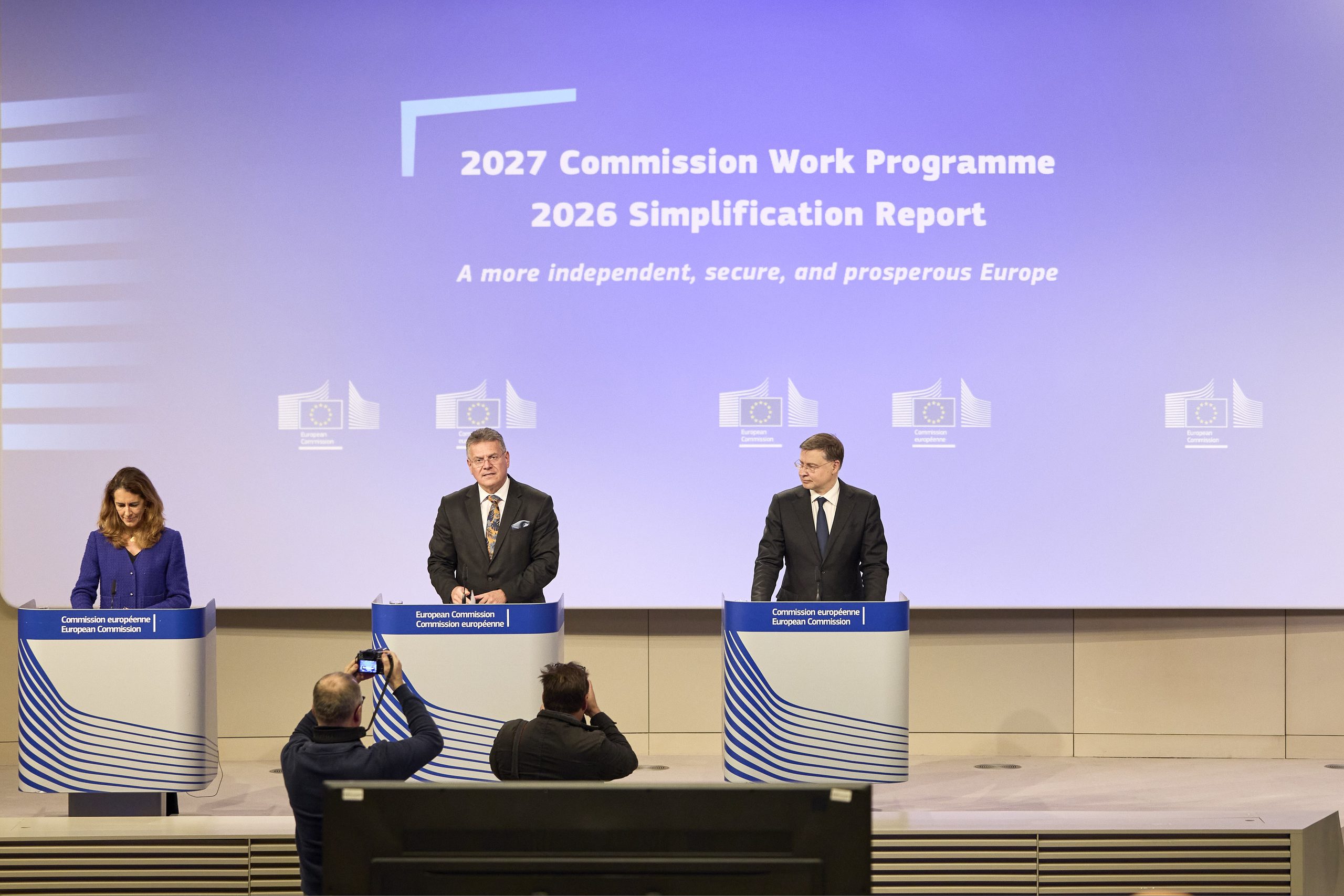
Buried in the Commission’s 2027 work programme, presented on 4 November under the title “European Union – standing up for one another”, is an unusual admission: Europe’s goal of being ready to defend itself by 2030 is “at risk”. That one line sums up the year ahead. Europe faces war on its border, an ally that has turned trade into leverage, and a competitor that controls critical supply chains, all with a divided political base at home. So what can a Commission still deliver in the second half of its mandate?
The answer, judging by the programme, is noticeably less than it was a year ago. It contains 23 new key initiatives, 10 of which focus on simplification. It also names 24 pending proposals it wants finalised quickly, 18 it plans to withdraw, and 14 old laws it intends to repeal. Last year’s programme announced 38 new policy objectives.
That difference is telling. The short programme is also a map of Europe’s constraints: what it leaves out and what it abandons says as much about the state of the Union as what it proposes.
So why so modest, Madam President?
1. The political centre of gravity has shifted
This is perhaps the most important factor, though it is rarely said openly in Brussels. Eurosceptic and sovereignist parties are in government, or share power, in a growing number of member states, and are rising in the polls in several others. That shapes what national governments are willing to accept in the Council, especially on files that transfer competence or add obligations.
The same applies in the European Parliament. The traditional pro-European majority of centre-right, socialists and liberals is narrower than before and less reliable. On several recent files, especially in simplification, the centre-right has relied on votes from parties further to its right to pass legislation. That makes it harder to build stable majorities for ambitious new rules and much easier to find majorities for reducing, postponing or revisiting existing ones.
Fewer new laws, more simplification, more flexibility for member states and more emphasis on security, migration and competitiveness are, in part, a response to where majorities currently lie. Not everyone reads it the same way: supporters see a Commission listening to concerns about overregulation, while critics fear political pressure is wearing down the EU’s environmental and social ambitions.
2. Much of the agenda is already on the table
The list of priority pending files reads like the Commission’s flagship agenda: the Industrial Accelerator Act, Chips Act 2.0, the Cloud and AI Development Act, the “EU Inc.” company framework, the Affordable Housing Act and the full set of proposals for the next EU budget. The Commission’s message to Parliament and Council is clear: finish what’s already there.
3. 2027 will be dominated by the EU budget
The Commission wants political agreement on the 2028–2034 long-term budget by the end of this year, so that funds can start flowing in January 2028. For many organisations, the real decisions about EU funding for the next seven years will be made in the negotiations on each spending programme. Without a deal, the defence, sovereignty and competitiveness instruments the programme announces remain frameworks waiting for funding, while larger member states invest nationally and widen gaps inside the single market.
So what is the programme really telling us?
1. Simplification has become the political glue
The Commission has proposed 12 “omnibus” simplification packages so far, which it estimates will save businesses €22.3 billion a year, almost 60% of its target for the mandate. Simplification is also one of the few themes that can still gather broad support across a fragmented Parliament and Council. The new “Pact against gold-plating”, targeting extra national requirements added when EU law is transposed, also shifts part of the responsibility for red tape to member states.
But simplification is not neutral housekeeping. Reopening a law redistributes its costs and benefits: a reporting duty removed for one sector is often a risk shifted to consumers, investors or competitors who had already complied. The €22.3 billion figure is the Commission’s own estimate and largely untested. A Commission that once championed “better regulation” now asks co-legislators to legislate quickly on less evidence. That is a legitimate political choice, but it should be called one.
2. Energy prices and geopolitics are reshaping the climate agenda
The Commission says it will stay the course on climate targets, but the approach has changed. The post-2030 energy framework is presented as a simplification package, and the programme mentions postponing some methane rules, reviewing state aid support for exposed industries and a short-term framework for refineries.
3. Reviews are where the contested politics will happen
Some of the most sensitive items aren’t new laws but reviews of existing ones: the nature protection directives (Birds, Habitats, Natura 2000), CO2 standards for trucks, the sustainable aviation fuel rules and the political advertising regulation. Farmers, hauliers and airlines will see an opportunity to fix rules they consider too costly. Environmental and civil society groups will fear protections being weakened. The Commission’s wording on nature, assessing whether changes are needed, leaves the outcome open.
4. The withdrawals are a cleanup, with a few telling choices
Most of the 18 withdrawals are files that have been stuck for years: the European Deposit Insurance Scheme (pending since 2015), the digital tax, two corporate tax files and the revision of energy taxation, all blocked by unanimity, the Green Claims Directive, the financial data access framework and the late payments regulation. One sits awkwardly with the programme’s language on democracy: the proposal on transparency of lobbying on behalf of non-EU countries, originally part of the Democracy Shield, will be withdrawn unless the Council makes progress.
Withdrawal is presented as tidying up. Politically, it is a record of vetoes: most of these files did not die in the Commission; they died in national capitals. Some business organisations welcomed several withdrawals; others will see the Green Deal and the single market being trimmed by attrition rather than by open debate.
5. Security has become the justification for almost everything
Chips, cloud, critical raw materials, energy, water, procurement and trade are now all argued in the language of security and dependency, even as the Commission concedes its 2030 defence-readiness goal is at risk.
The security framing lets Brussels act in areas the Treaties largely leave to member states. It also lowers the bar for scrutiny: measures justified by security face fewer questions about costs, competition and proportionality.
The open question is whether security has become Europe’s strategy or its alibi. A Union that cannot agree to tax energy or insure bank deposits together may find it easier to agree on threats than on solutions.
6. Europe’s voice abroad is weaker than its vocabulary
The programme speaks of independence and partnership. Measured against the world it faces, Europe looks less like an independent power than a rule maker negotiating from a defensive position.
On trade, Europe’s response to Washington was accommodation, not deterrence. Under the transatlantic deal implemented in 2026, the EU removed tariffs on US industrial goods and accepted a 15% US tariff on most exports. Europe’s answer now is diversification: new trade agreements, closer ties with Canada and a “geoeconomic deterrence pact”. The tools are real. Whether the EU will use them against a security ally is the untested part.
On technology, Europe still writes rules that others study, and recent Digital Services Act enforcement shows it is prepared to apply them. But it does not own the platforms, models or chips those rules govern. The risk is regulating non-EU technologies while subsidising a domestic alternative that arrives too late.
On sustainability, Europe built its global voice on climate leadership. At COP31 it promises not to backslide on fossil fuels while, at home, it withdraws Green Claims, reopens nature laws and revisits CO2 limits for trucks. Partners in the Global South will notice the gap between external commitments and internal retreat.
So how do we play the second half?
A delivery-focused Commission working with a fragmented Parliament and Council changes where influence lies. Here is where we see the openings in 2027:
- Focus on the co-legislators. With 24 priority files in negotiation, most of 2027’s decisions will be made by Parliament and Council. That means working with rapporteurs, political groups across the spectrum and member state representatives, with concrete amendments rather than general position papers. In a fragmented Parliament, map majorities, not just positions: outcomes depend on which coalition forms on each vote.
- Shape the open initiatives early. For several new initiatives, the Commission has not yet decided between legislation and guidance, and some have no date. Consultations and impact assessments are where their scope will be set.
- Bring evidence to the reviews. Whether you want the nature directives, truck CO2 standards or aviation fuel rules reopened or protected, the evidence is being collected now.
- Act fast on withdrawals. The Commission intends to withdraw the 18 files within six months. If one matters to you, this is the last chance to show it has political support.
- Don’t neglect national capitals. With more Eurosceptic governments, a gold-plating pact and a stronger focus on implementation, a growing share of decisions is made nationally. An EU strategy needs a national plan alongside it.
- Engage on implementation. Commissioners have met over 1,500 stakeholders in “implementation dialogues”, and the Commission opened 874 infringement procedures, the highest in ten years. Feedback on how rules work in practice is now part of the policy debate.
So what’s next?
The programme will be presented to ministers on 19 November. Then the three institutions will agree a joint declaration on their legislative priorities for 2027. That declaration will show which files the EU actually commits to finishing.
The programme’s weakest points are the ones it presents least candidly: files abandoned under national vetoes, a sustainability agenda in retreat at home while Europe asks for ambition abroad, and a security agenda still waiting for its budget. For organisations engaging with the EU, success next year will depend less on reacting to new proposals and more on understanding shifting majorities, both in Brussels and in national capitals.
So, which files are on your 2027 watchlist? We’d be glad to compare notes.
If you’re interested to have more information on this field of expertise, don’t hesitate to contact Eda Aygen or Pierre Deraedt, partners at SoWhatCommunications powered by Square Circle.
Contact us: info@sowhatcoms.com
More information: www.sowhatcoms.com – www.squarecircle.be