
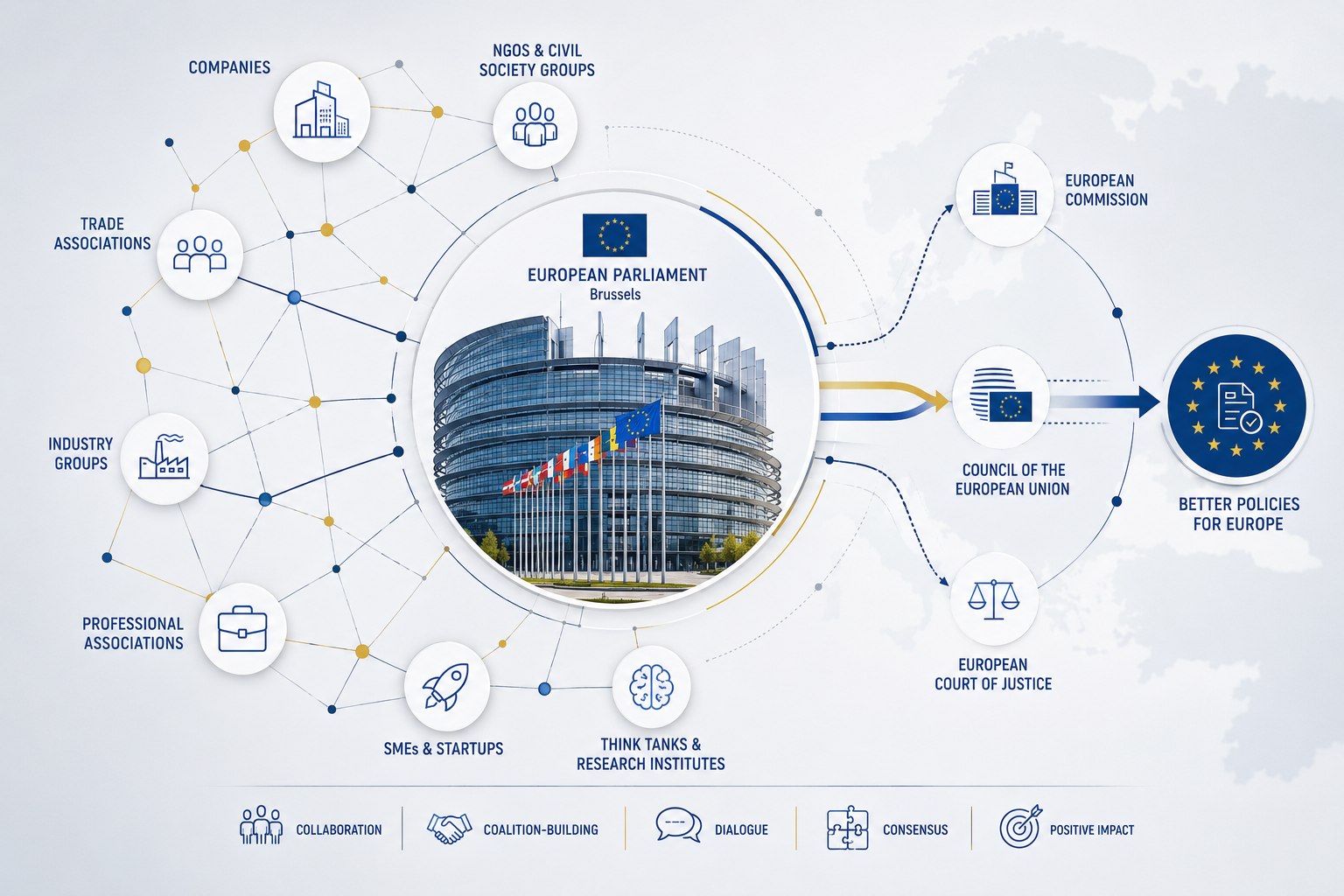
Most companies today are members of multiple associations. They join sector federations, cross-industry platforms, and trade associations, often for valid reasons: to stay informed, to remain visible, or to align with peers.
But for companies serious about shaping the regulatory environment in Brussels, creating coalitions is one of the most powerful and underutilised tools available. Used strategically, it can amplify your voice and open doors that no amount of direct lobbying alone would.
Here is how strategic coalition-building can become the backbone of your EU public affairs strategy.
By Eda Aygen, Partner at SoWhatCommunications Powered by Square Circle
Why Brussels runs on coalitions
The EU policy process is, by design, a process of aggregation. The Commission consults broadly. Parliament works through compromise. The Council reconciles 27 national positions. In this environment, isolated corporate voices — however well-resourced — carry limited weight compared to a unified industry position.
EU institutions actively prefer engaging with representative bodies. When the European Commission opens a consultation or launches a green paper, the responses that shape official thinking come from BUSINESSEUROPE, Eurelectric, or DigitalEurope — not individual companies. This reflects the Commission’s need to ground proposals in broad stakeholder consensus rather than any single actor’s preferences.
For public affairs teams, this means the first question is rarely “what do we say?” but “who do we say it with?” Associations are the infrastructure through which coalitions are built, maintained, and deployed.
Choosing strategically, not automatically
Many companies join associations by default — by sector, by geography, or because competitors are members. A smarter approach starts with mapping: which bodies have the greatest credibility and access on the issues that matter most to your regulatory agenda over the next three to five years?
The Brussels landscape divides into three tiers:
- Pan-European peak federations (BUSINESSEUROPE, ERT) offer access at the highest political level with significant institutional weight.
- Sector-specific European federations (EFPIA, ACEA, DIGITALEUROPE) combine deep technical expertise with targeted access to relevant DGs and parliamentary committees.
- National associations with Brussels reach (BDI, MEDEF) matter because Council negotiations are shaped by member state positions — and influencing those begins at home.
The strategic question is not how many associations to join, but which combination gives you the best coverage of priority issues, the most credible coalition partners, and the right balance between influence and cost. Sitting on a committee where your voice is drowned out by competitors with divergent interests is worse than not sitting at all.
The rise of issue-based coalitions
The Brussels landscape is no longer shaped solely by traditional sector federations. A newer actor has emerged: the issue-based coalition, formed not around a sector but around a political moment.
As the EU legislates on cross-cutting themes such as digital sovereignty, strategic autonomy, industrial competitiveness, companies from different sectors find themselves united by shared policy stakes that no single federation can represent alone. The response: cross-industry coalitions built around a single, politically significant agenda.
Recent examples are striking:
- Digital sovereignty: European tech companies and cloud providers coalesced around reducing dependence on US hyperscalers, crystallised in the EuroStack framework backed by Parliament’s ITRE Committee in June 2025.
- Industrial competitiveness: The 2024 Antwerp Declaration, convened by CEFIC, broke sectoral boundaries to attract over 1,300 signatories, ultimately shaping the Commission’s Clean Industrial Deal.
- AI regulation: 56 European AI companies including Mistral AI and Aleph Alpha formed a coalition in July 2025 to push for AI Act simplification — directly influencing the Commission’s Digital Omnibus proposals.
These coalitions share key characteristics: they form quickly in response to legislative threats, they are built around politically resonant narratives, and they speak with a clarity that broad-membership federations — constrained by internal compromise — sometimes cannot match.
The implications are clear. Where issue-based coalitions produce unified positions in weeks, federations still working through internal processes risk becoming afterthoughts on high-profile dossiers where timing is everything.
Both layers are necessary
Some associations are adapting and leading; others are being overtaken. For companies navigating this landscape, a sound public affairs strategy requires asking not just which associations to join, but which coalitions — whether led by associations, companies, or both — are most aligned with the political moment and most credible in the rooms where key files are decided.
In some cases, the most effective move is not to join an existing coalition but to convene one. When no existing body adequately represents a company’s position – because the issue is too novel, too cross-sectoral, or because incumbent federations are constrained by conflicting member interests – stepping into the convener role offers a distinct set of advantages.
The company that calls the first meeting sets the agenda, frames the narrative, and shapes the coalition’s political asks from the outset. The early-mover advantage compounds: policymakers and European Institution officials tend to engage most closely with the organisations that brought an issue to their attention, not those that joined the chorus later. There is a credibility signal in convening: it communicates to institutions and peers alike that a company has both the vision to identify an emerging regulatory risk and the standing to mobilise others around it.
The threshold is lower than most public affairs teams assume. A focused coalition of five to ten well-chosen partners, united around a precise and timely political ask, will consistently outperform an overstretched federation still negotiating its position paper internally. The question is not whether your company is large enough to lead; it is whether the gap in representation is real, the timing is right, and the right partners are available.
Traditional memberships and issue-based coalitions are not alternatives. Increasingly, both are necessary.
So what can we do to help your company building alliances that move policy?
Building a high-performing EU public affairs strategy requires both deep institutional knowledge and disciplined strategic thinking. That is where we come in.
Whether you are entering the Brussels arena for the first time or looking to sharpen an existing strategy, we work with clients to map the regulatory landscape, identify the associations and coalitions that matter most for their agenda, and develop the positions and stakeholder engagement plans that turn membership into measurable influence. Get in touch!
If you’re interested to have more information on this field of expertise, don’t hesitate to contact Eda Aygen, partner at SoWhatCommunications powered by Square Circle.
Contact us: info@sowhatcoms.com
More information: www.sowhatcoms.com – www.squarecircle.be